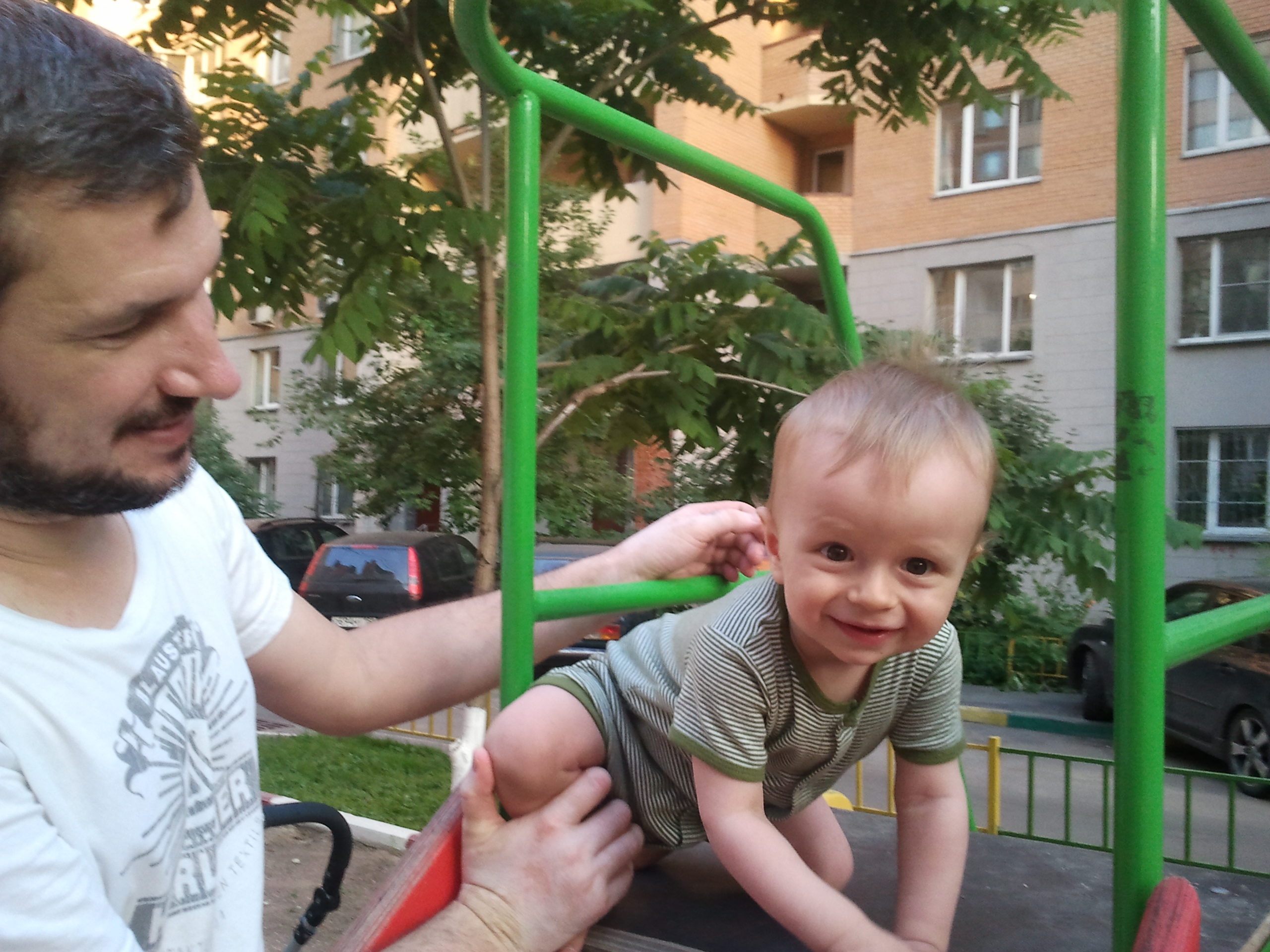
A picture of Lev on a slide with daddy

It’s been a dark few days, personally and professionally. We did hold a wonderful debate at The Moscow News on the subject of Russia’s image abroad. You’d think this kind of event would be tense, especially in light of the recent deadly flash floods in the south of the country (and the relief for that is ongoing, by the by – with the riot police, United Russia deputies, Duma opposition members, and non-Duma opposition members standing side-by-side in their efforts to provide help), but it was wonderful, actually – putting an emphasis on professionalism in PR, on official accountability, on easing the visa regime. At the same time, the debate only reminded me of the gulf between real Russian industry professionals and Russian bureaucrats – it is the latter who wield a whole lot of power and bear not a whole lot of responsibility for much of anything. Not all of them are like this, of course – just look at Moscow’s culture department for examples of effective management – but it’s still early days yet. The collective Soviet hangover has not yet passed for so many people.

And I’m tired. I’m tired, and I feel a bit like a cornered animal. I want to go to the dacha I don’t have. I want better luck – or, rather, I want more good luck. More decent luck. The kind of luck you can display on your mantlepiece (if we ever have a mantlepiece).

But I come home to Lev and Alyosha in the evenings. I change my shoes and we go for a walk. Lev walks holding daddy’s hand – and yells in outrage should daddy deign to fob him off on me. It must be something about daddy.

Irresolution

If I could pick one word to describe Russia today it would be “uncertain.” Doesn’t strike you as the right kind of word at first, does it? What is this? “An uncertain Russia”? How can a country be uncertain?

And yet uncertainty is the biggest governing force both in Russia’s daily life and the more abstract processes that are otherwise known as “Russian politics” or “Russian public discourse.” Uncertainty is like the weather. Or not, actually – uncertainty makes the weather.

For the standard expat, the kind who’ll spend no more than five years here, at most, the uncertainty is still palpable. Will I get my visa renewed on time? Will I get my visa renewed at all? Why are rent contracts here no longer than a year? How come I don’t know my neighbors at all?

For the expat who has decided that she wants to stay, the uncertainty takes on a greater shape, like a shadow growing at the foot of the bed. Will I ever be able to get residency? What if the ever-changing legislation result in me getting separated from the kid who’s just fallen asleep with his head on his toy rabbit and the husband whose tattoos I can trace with eyes closed? Will there still be a military draft seventeen years from now? Where in the world do I go should everything fall apart? Everyone should be so lucky as to have something that can be destroyed in the first place, I suppose.

Russian businessmen at the top of the food chain, clamped to the very mouth of the oil pipeline in a kind of kiss, have wobbly, uncertain dreams. Police generals walk with an uncertain gait. Models in advertisements for home loans and new cars have wary, uncertain smiles.Tajik guest workers in neon-colored vests engage in meandering, uncertain arguments with the displeased grandmas parked permanently on a playground bench.

“Anyone in Russia can end up in handcuffs,” says Nadezhda Tolokonnikova, jailed member of the punk group Pussy Riot, at her latest, Kafka-esque court hearing. The policemen inside the courtroom appear smitten with her.

“They can lock up anyone around here,” my new landlady, daughter of Crappy Landlady (RIP), confides in me over tea. The new landlady is a matronly retiree, a former City Hall worker who votes for Putin and thinks that every modern apartment should have a bidet. She’s also engaged in a fierce legal war with her father – who’s trying to have her boyfriend jailed on assault and battery charges. The conflict goes back to the old, Bulgakovian “apartment question.” The apartment in question is the one we are renting, though there are more properties that will soon be in dispute. This is what often happens when a family member dies in Moscow – the absurd real estate prices, highly influenced, no doubt, by the record 79 billionaires who officially call Moscow home, will do that to people. The billionaires are themselves uncertain – like airy, porous apparitions, blown every which way by the wind.

Mark Galeotti calls Russia’s real decision-making apparatus the Deep State, and he describes it now as being “in deep water.” It makes me think of Adrienne Rich, diving somewhere where the sunlight does not quite penetrate. It’s dark and cool there – and peaceful, the enormous pressure at that level rendering sudden movements impossible. Those who are down there, do they envy the surface as much as the surface envies them?

In the evenings, we walk on the eastern edge of Moscow, waiting for the baby to fall asleep in his stroller. The new ducklings on the ponds have already gone from yellow to brown. I realized recently, that my desires have not changed much since I was thirteen years old. All the girls want to love, and be loved and star in an epic of their own making. And in all of the epics – you can see the end, and yet the end is still surprising.

*wink*

*nudge*
Lev helped me report on today’s protest rally in downtown Moscow

The Left Front is too far… left to his taste. He did mention the need for rule of law, and expressed his disappointment with the fact that the Investigative Committee was actively denying the fact that lawyers were at first barred from entering the apartments of opposition figures as they were being searched yesterday. Finally, he gave up and sang “ee-eye ee-eye-oh.”

That one “Dealbreaker” piece on the college girl and the punky dude

I’ve of two minds about this piece. The headline is misleading, for one thing. And it starts out as if its trying to bait you – “I went to college… because that’s what people like me did.” As someone whose financial future has now pretty much been ruined by student debt, I have a knee-jerk reaction to people who speak about their college experience this way. Still, considering the debate it has inspired, I’ve been moved to point out that:

1. I have tremendous sympathy for the author. I know what it’s like to be young, earnest, in love – and going through a bunch of complex mental and emotional contortions in order to deny that your relationship is actually failing. There is a sad, Potemkin Village-like aspect to it that breaks my heart. “As my vocabulary expanded among my academic peers, the shared language of our relationship narrowed: What time will you be home? I love you. Pick up a pizza? Touch me. Don’t leave.” That’s one of the saddest things I’ve read all week. It’s also very self-aware. And it’s plain good writing.

2. I also feel that there is something unspoken going on in the piece. I think the author has some insecurities about herself that she is not yet ready to vocalize. I think Duke, the ex-boyfriend who didn’t go to college, actually made the author feel pretty good about herself and to deal with those insecurities – at least in the beginning. He is her foil in the story. She’s ambitious, she’s lived abroad, once again, “[her] vocabulary expanded.” He’s the dude without a job, without a degree – and, it is heavily implied, without any direction. Hey, she’s the good girl from the right side of the tracks, and she tried to work it out, but it still didn’t. There is the distinct air of someone who, while in love, was also “slumming it” with Duke – precisely because Duke was so different from her. His presence must have helped her see herself in a different light, to renegotiate her own relationship boundaries, to appreciate her own intellectual curiosity, to define what she wants and what she doesn’t want. And that is not acknowledged. And this is, perhaps, what really rankled people. There is an aspect of “relationship tourism” going on here which is mostly FINE (plenty of people will say that my ex was “slumming it” with me – his family had money, mine didn’t, for one thing – but that’s not all there is to the story), except that it exists between the lines. There seems to be a lack of ultimate emotional honesty that makes or breaks pieces in the “Dealbreaker” series.

I don’t wish to slam the author – this is her life, she’s just relating it. But I can understand why this piece is garnering an annoyed reaction. Because there is something missing in it, a curious blank spot at the center of her experience, and that doesn’t seem fair – to her, to Duke, or the reader. It’s as if we were treated to a very vivid glimpse of a real-life drama – but only that, a glimpse.