
Alpha. Vyazniki, Vladimirskaya oblast, Russian Federation.
I can’t take pictures worth a crap – and this certainly doesn’t do Alpha any justice. Still, you can imagine what she’s capable of when she’s in the right sort of mood.
The sky is high. The Czar is far.
Alpha. Vyazniki, Vladimirskaya oblast, Russian Federation.
I can’t take pictures worth a crap – and this certainly doesn’t do Alpha any justice. Still, you can imagine what she’s capable of when she’s in the right sort of mood.
I have walked into D&D games and had some snarky asshole male gamer ask me where my chainmail bikini was, or give me shit for wanting to play a fighter rather than a cleric or a mage…
Ren, Sexism in Gaming series
I like drawn out, single-player RPGs with a bunch of side quests – games I come back to for months on end, which are an entirely private experience (private, in the sense that I’ll have an amused member of my household stand over my shoulder and say things like, “Just give up on the Deathclaws* already”). I don’t really want to interact with other gamers most of the time; hell, I don’t even connect much to the “Little Big Planet” network. I’m a lone wolf, goddamit, and I just don’t want to deal with douchebags. And even if you don’t have voice chat, the douchebags will pick you out if you happen to have a female-sounding nickname in particular.
Still, because I invest so much time and energy in my characters, I do, occasionally, want to share them in some way or another. When I was playing “Elder Scrolls”, I was particularly proud of my character – a female Dark Elf I named Mido (I named her after my then-boyfriend’s brother, because I bought the game around the time of his high school graduation, as corny as it sounds). Mido was a warrior character, specializing in swords and heavy armour. Some of that heavy armour made her look a little bit ridiculous, but I still give props to the game designers – no stupid chainmail bikinis for my Dark Elf.
Now, there are plenty of cool spells and the like in “Elder Scrolls,” but I always felt more confident with a sword. And what I found is that many people viewed the mage-type characters as having been designed exclusively “for girls.” Why? A whack of the sword indulges my inner bloodthirsty savage, dammit. In “New Vegas,” I similarly enjoy blowing the heads off various people and creatures. I can’t wait for the inevitable bloodshed and doom of “Skyrim.”
I don’t think there’s anything inherently “girly” about a mage character either. In “Elder Scrolls,” I found magic trickier to pull off, truth be told. I could never aim my spells right, for example – and I was often pretty lax about acquiring the more complicated ones (until I got to the Mages Guild storyline, I suppose). I always felt that battle magic in “Elder Scrolls” required more work, and as such, was more challenging.
Same goes for sneaking and archery skills in “Elder Scrolls” in particular. The former I eventually mastered, the latter I pretty much consistently sucked at. In analyzing why, I’ve come to the conclusion that these activities weren’t nearly as useful to me in channeling my own aggression. Like Ren points out in her series – gaming is often about being able to be someone you’re not, someone you want to be. I’m not good when it comes to anger issues – wiping out a nest of vampires in a cave somewhere does actually help, even if all of the action occurs on a television screen.
Snobs dismiss gaming as mindless escapism, but the act of escaping is never particularly mindless. It tells you a lot about yourself – as you get busy lovingly putting down a bunch of frag mines in order to appropriately welcome an approaching Deathclaw or get ready to finally say goodbye to Umaril the Unfeathered, the Liberace to Dagon’s Rob Zombie. I have found the escapism especially useful while pregnant, because it’s not as if I can run a few kilometers right now in order to deal with rage. Angry pregnant ladies, take note: gaming can be good for you.
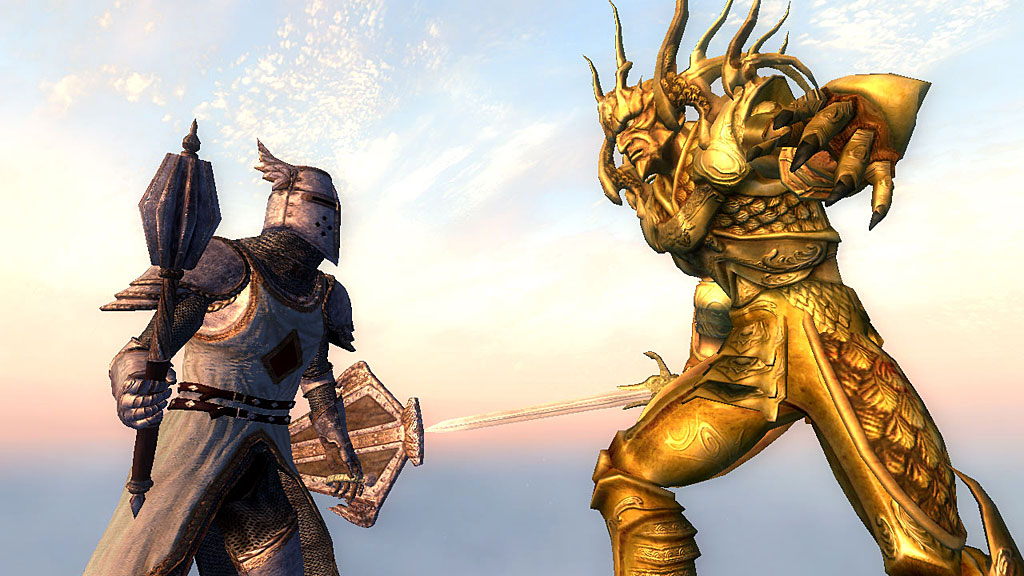
As a writer, I pay special attention to plot arcs in RPGs, and I find the whole structure of games to be very useful when it comes to writing fiction, though that’s a whole other story. For now, I’m just grateful that the medium exists in one way or another – and I’m glad that it’s evolving. And being an asshole to women because more and more of them are also claiming it as their own will, hopefully, get old eventually. I mean, look at it that way – my husband likes me way more after I’ve just killed a bunch of zombies. I become a more pleasant person. Everyone wins.
* – For those who aren’t familiar with the Fallout series, Deathclaws are bad motherfuckers, and not in an endearing, Samuel L. Jackson way either. They look like Satan on dinosaur legs, and repeatedly hand your ass to you.
Ren is writing about it. This is a good thing. I look forward to more.
Even a cursory glance at the coverage of the Schwarzenegger cheating-and-paternity scandal shows that WAY too many people still believe in the whole idea of “legitimate children” and “illegitimate children.” It goes beyond mere word-choice. The “illegtimate child” has an aura of embarrassment attached, at best. Oops, your parents messed up, and produced you! If only your dad had kept it in his pants and/or wore a condom! Or else, the child is viewed as an oughtright inconvenience. Some people even think that laws should be rewritten, so that the little “bastards” in question should not threaten a “legitimate” family’s finances.
This gif sums up my feelings on the matter:

I’m not one of those people who can honestly say that she loves her neighbour (especially not when he’s blasting really bad techno at 2 a.m.) or turns the other cheek. Like any person, I’d be pretty pissed off if my husband went off and had a kid with someone else, and I was in the dark about it. The reason why so much aggression and discomfort centers on the child has to do with the fact that the child serves as living, breathing “evidence” of a betrayal. People often project their own insecurities about their relationships onto children like that, without even knowing the child personally or consciously acknowledging what it is they’re doing. All of that is perfectly understandable.
None of it excuses the ridiculous label of “illegitimacy.”
Yay.
The one thing I really didn’t mention in that post is how naturism has been a big part in helping me deal with chronic pain – most likely because so much of it centers on the idea of self-acceptance. You don’t go strolling naked into the waves without a sense of acceptance, I don’t believe. Not in this day and age, anyway.
 Natalia A.