Speaking of scourge: the Kushchevskaya massacre

Don’t read this if you don’t think you ought to.
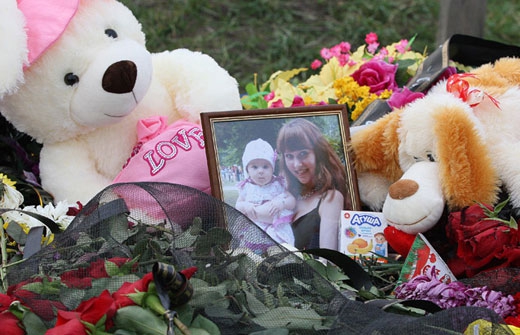
At the grave of Yelena Ametova and daughter Amira. Photo: Alexander Lomakin.

In case you haven’t heard about it – and if you’re not in Russia, you probably haven’t – twelve people were massacred in the village of Kushchevskaya on November 4th, during a holiday weekend. Most of the victims, who had gathered to celebrate November 4th (Day of National Unity, as it’s called nowadays), were knifed to death. Not even children were spared. A nine-month-old baby girl was choked to death.

Only the dog was treated humanely – like something out of “Lethal Weapon 3” – the killers neutralized it by injecting it with a tranquilizer, and it’s reportedly alive and well today.

The massacre caused such an uproar that First Deputy Prosecutor General Alexander Bastrykin flew in to oversee the investigation. So far, four people have been detained in connection to the killings – the youngest is 16, the eldest is 24. Journalists who were able to get a brief look-in described one of them as a “little wolf”.

It should go without saying that massacres of this scale are almost always “ordered”. So far, the tabloids are pointing to some rich guy who’s currently “at his villa in Italy – or Spain”. Is there hope that the people who financed one of the most horrifying mass murders in recent memory will be brought to justice? I don’t know.

I know what it’s like to be targeted by criminals and to constantly be on the look-out. I experienced this as a child. I can well imagine the horror the children in Kushchevskaya went through before they were murdered. If there’s anything that I have learned about these kinds of situations – anything that the 1990’s taught me – is that at least some of the children were probably killed first, so that the parents could watch.

These types of killings serve a dual purpose – eliminating “inconvenient” people and, also, terrorizing the countryside. The massacre was meant to send a message – “This is what will happen to you and your family if you cross us – big important people.” The message is also – “The police can’t save you. The government is not in charge here. We are. We get to decide who lives and who dies.”

Now, as I mentioned earlier, I am glad that there is a moratorium on the death penalty in Russia. At the same time, I think it’s important to point out that the people who order such killings and the people who participate them usually cannot be rehabilitated. They are nothing. They have forfeited their right to be considered members of humanity. Although, as a religious person, I believe in redemption, I believe such redemption can only happen between an individual and God. The individual and society, on the other hand, should call it quits permanently when something of this magnitude occurs.

Is it not also society that allows these killings to take place? To an extent, yes. We live within a caste system in which some people have long since decided that they are above all laws – human and spiritual. And then there are also those who desperately want to join them in their places of power. The Kushchevskaya killers were professionally prepared for the task at hand. Why? Because it’s a career thing.

Unlike their victims, the boys with the knives had no interest in being mere farmers – even well-to-do farmers. They want success and they want it fast – they want the luxury of utilizing the services of upscale prostitutes, they want that flat-screen TV, the nice car. If I know anything about what makes these boys act the way they do, it is this: they’re well aware of the fact that you can’t have a decent life via decent means. If a bunch of people need to die in order for them to achieve higher status, then yeah, those people will die.

Jamil, the son of the man whose house was targeted, lost his father, mother, wife and baby daughter. Jamil’s father was Muslim, his mom was an Orthodox Christian. A local Orthodox priest allowed the mother to be buried next to her husband at the Muslim cemetery following an Orthodox Christian ceremony. “This land is one land,” the priest was quoted as saying. Jamil’s wife, Yelena, was 19 years old. So far, investigators are saying that she was already dead by the time the killers got around to killing her baby. Which is, I suppose, a good thing when you think about it – although the word “good” doesn’t feel right.

“Little wolf” is an astute characterization, by the way – although it is massively unfair to wolves.


Steven Hayes: is the “I’m against the death penalty, but…” discussion appropriate here?

I shouldn’t be in any condition to write anything about the Petit family massacre. But I am. I’m working on a new play, a tragedy, and I have found that my mind has begun working in completely new ways. I think about evil – banal evil, sophisticated evil – and I let it in as close to me as it can go. Evil is like a dog sidling up next to me, asking to be petted.

So.

A few days ago, Steven Hayes, one of the perpetrators of a home invasion that turned into a massacre in Cheshire, Connecticut, was sentenced to death. One of the jurors on the case spoke at length about how he personally doesn’t believe that the death penalty works – but that the law was applied justly in the case of Hayes.

It’s a horrifying story, either way you look at it. It was a situation in which nobody had to die – and yet a mother and her two daughters perished, having first gone through extreme terror and suffering. The father, the sole survivor among the victims, lost the people closest to him in the course of a single day. And for what? Fifteen grand? A few strings of pearls? The mind boggles.

I like how after the jury handed down their recommendation of a death sentence, Dr. William Petit talked about how there could be no “closure” in a situation like this. I suppose people do find ways of functioning when dealing with such grief – but the word “closure” may not necessarily apply. The destruction that Steven Hayes and Joshua Komisarjevsky visited upon the Petit family is so inhuman as to make most words ring hollow after a while. A verbal response to this tragedy feels lacking.

So all of this brings me to other responses to such tragedy, namely to the death penalty. Continue reading “Steven Hayes: is the “I’m against the death penalty, but…” discussion appropriate here?”

Change freaks me out

I realize that dedicating a blog post to how change freaks me out is the height of narcissism – because most people are freaked out by change on one level or another, and the truth is, we rarely say anything interesting about it.

But walking home yesterday, maneuvering around rain puddles (what COMPELLED me to buy suede boots? I NEVER buy suede boots! I don’t even care that I’ve been waterproofing them – it doesn’t make them any less suede!!!), I’ve had to reflect on how much my life has changed.

I didn’t plan any of it, truth be told.

I never planned to be a journalist in Moscow.

Well, what would you have liked to do, Natalia? – You’ll ask.

I don’t know.

I would have liked to go to Hogwarts, I guess. I would have liked to have seen the Great Orion Nebula up close.

My imagination is always bigger than my life. I guess I’m lucky that the one definite and realistic thing I have always wanted was to be a writer. Because otherwise – damn.

But I also live in this place where I don’t feel safe. Oleg Kashin was beaten within an inch of his life – in my neighbourhood, for God’s sake. I don’t know what the future will look like. I sometimes feel as if I have no future at all.

And you will say – there is no future. Just the present, rolling in like a wave. There’s no sense in trying to guess the shape of something you can’t grasp. There’s just the street at night. Puddles splashing and calming down again like seas after a storm in the eyes of God. A black poodle on the corner, blending in and out of the dark. And a light in the window of the place you’re coming home to.

The sleeping season

I pretty much fall asleep everywhere I go these days. Standing up on the metro, I bury my face in my sleeve, and sleep like one of those horses who can do it without lying down. Sitting down on the metro, I rest my head on The Man’s shoulder, and literally a minute and a half later he has to nudge me awake as we reach our destination. I fall asleep on the bus stop while waiting for Gmail to load on my phone. I fall asleep during the 20-second trip on the elevator. At work, I put my head down next to the keyboard in a joking manner, just to show everyone how tired I am – and then I fall asleep. “Young woman, are you sleeping?” Someone asks me in line at the bakery, and I answer truthfully, “Yes.” I’m not even awake enough to register embarrassment. I catch myself beginning to nod off as I stand on the escalator. Friends prefer booths in restaurants – but I know what’s coming; give me a seat comfortable enough, and my eyes will start closing by themselves before anyone even brings me my soup. “Am I boring you?” A colleague asks me when I start to make myself comfortable against the glass display case in the lunch line, just as he’s getting to the climax of that one funny story this one dude at Interfax told him.

If I sleep, then it follows that I also dream. Dreams on the metro are all work-related. Dreams in restaurants are fuzzy and disordered, November-coloured, blackberry-flavoured. The same evening from my childhood gets recycled – going to see my aunt sing in “The Marriage of Figaro” in Kiev in an autumn not unlike this one, the ground full of puddles and the sky full of clouds and stars, and me full of anticipation. People who have died a long time ago walk with me through these dreams – and we part ways, always, at the same street corner.

I dream that St. Vladimir has swept the stars off one of the domes at the Kiev Pechersk Lavra, and shook them out of his sleeve at a table in front of me, and said, “pick one that looks back at you.”

Other people dream about me. My father visited my cousin at the hospital, and my aunt pulled him aside and said – “I had a dream about Natasha. She was so happy. What’s going on with her?”

What is going on with me? I can’t begin to say.