Someone writes a critique of, say, a TV show. Then someone else critiques the critique. Then a legion of ANGREE PEOPLE shows up in the comments section of the critique that’s critiquing the critique, furious about some WORD that the critic used, a word that is OFFENSIVE in some contexts, though perhaps not in others. The outrage spreads to Twitter, and causes exasperated status updates on Facebook, which then prompt philosophical debates in the comments to said updates – debates that are Godwinned within 24 hours, because that’s just how some people roll.
I don’t know about you – but I’ve got, like, real life white pride marches and violence against journalists in Moscow getting most of my attention these days. If someone pisses me off on Twitter, I might flame them for a second, then get on with my freaking day.
Call-out culture seemed meaningful when I was younger, richer and stupider. I have a child now, for God’s sake. I have a husband. We’re adults. We go to IKEA and stuff. I’ve got the receipts to prove it!… I seriously have better things to do.
So I finally saw this movie as part of the opening of the 2morrow festival here in Moscow. You might say that as the parents of a little boy, Alexey and I probably should not have seen something like this, particularly on the day that Lyovka turned 3 months old (3 months! Amazing! An entire season of Lyovka!). Yet I’m one of those people who believes in fighting fire with fire – namely, I try to confront my worst parenthood-related nightmares via books and movies. No point in trying to run away from stories such as the one told in “We Need to Talk About Kevin.” Well, inasmuch as this film actually tells a story.
I haven’t read the book, so I can’t tell if this is a faithful adaptation. And I’m not sure if I want to read the book now, because there is a great hollowness at the center of the film adaptation, and it’s got nothing to do with all of that nietzschean “the abyss looking into you” crap. Quite frankly, I just wasn’t that taken with the characters. I ultimately decided that I couldn’t care less as to why Kevin, the title character, is such an utter sociopath – in most scenes, he was just too smooth and polished, I suppose, to come off as real. The soundtrack was a little too ironic – all of those cheerful oldies songs worked for about 20 minutes or so before they became redundant. The great and glorious Tilda Swinton spent entirely too much time washing red paint from various parts of her body and house – I got the visual metaphor the 100th time around, thanks, the 101th time it was shoved in my face made me wonder if director Lynne Ramsay thinks the audience is full of idiots.
By contrast, the real-life sociopath Eric Harris, as described in Dave Cullen’s “Columbine,” struck me as pretty interesting. I suppose this is an unfair comparison, considering that Cullen wrote a nonfiction account of a real-life school massacre – but there was also something gratifying about the way in which Cullen treated his subject matter. He didn’t beat the reader over the head with all of this “ooooh, let’s explore the depraved world of a sociopathic mass murderer” stuff. When you’re dealing with something as horrifying as the events that took place at Columbine High on April 20, 1999, the facts on the ground will speak for themselves.
This isn’t to say that Ramsay isn’t masterful – she is. When she pulls off a scene, she doesn’t merely pull it off – she scores a freaking home run. Who needs to show a school massacre, for example, when a single shot of a blond cheerleader type screaming for help from behind a locked door is chilling enough? When Ezra Miller verbally eviscerates his mother in the middle of a restaurant, you immediately realize what a great director had to have been involved here – to get Miller to totally hold his own in a tense scene with Tilda fucking Swinton (do I hero-worship her too much? Probably). “We Need to Talk About Kevin” is ultimately a movie that’s been overcooked, but it’s also the kind of movie that makes you want to watch more of Lynne Ramsay’s work. And that says a lot – because I’m not one of those epic film junkies who has to know what’s going on in the industry 24/7 (which, considering my present career trajectory, is a bad thing… hm…), and my days of trying to write actual film criticism are pretty much behind me.
All the way in Moscow, it was just nice to get a glimpse of the doors of an American high school, really. Those doors I am nostalgic about… the ones that the evil Kevin locks with yellow bike lockers. Is it bad that I was just looking at them and going, “I want to hear the click and hiss of those doors one more time”?
He looks like daddy, but has my hair colour. Not that you can tell from this picture, since most of the hair that exists on his head is currently in the back.
Also, the so-called auto-focus is a sick joke, haha.
Even after living for just a year and a half in a given city, certain places begin to accumulate memories. Good or bad, the memories are like barnacles – which is to say that they endure, remaining prominent in your mind until new ones calcify on top.
“Now, the Moskvoretsky Bridge…” I said to my brother-in-law on our downtown walk together.
“…Is also a place where you and Lyosha kissed,” he interrupted.
“No! Although, maybe – yes. You can draw an entire city map based on the places where we have made out. I think we’ve certainly covered all of the directions that the metro takes you. But that’s not it. Moskvoretsky involved this incident with a truck full of soldiers. It pulled up next to me on the bridge one evening. I was 17 years old and visiting Moscow. The soldiers started asking me to hop in. I was very scared. But in retrospect, I don’t think they meant any harm. It was summer. I think they were just trying to enjoy themselves – and wondering if they could enjoy me too.”
“Soldiers will do that.”
“That they will.”
We sat under a tree in Alexandrovsky Garden, watching the tourists watch the Changing of the Guard by the Kremlin wall. Back when I was working my first job, at that fine institution know as Regal Cinemas, located at Stonecrest, a nice strip mall (if strip malls can be nice) in south Charlotte, my managers used to try to piss me off by imitating soldiers at the Eternal Flame WWII memorial, carrying brooms for emphasis. It never worked. Or else it did work – and I just tried to not let on about it.
The real Eternal Flame soldiers made me think of my grandfather in his youth. There is that tiny grain of pain that sits in my chest and is stirred briefly when I remember him. I’ve been trying to get it to stop hurting ever since I moved to Moscow. Men whom my grandfather thought of as boys in his time are thinking of finishing their military careers. Time ought to heal – I ought to find a way to let it.
My brother-in-law and I ate bananas and talked about the Russian Landscapes photo exhibition we saw on Manezhnaya Square. As usual, I was impressed by Kamchatka – also, the Krasnoyarsk region, and a gloomy photo of a winter night in Norilsk.
“I mean, Norilsk!” I told my brother-in-law. “It exists! Out there, somewhere! I have only scratched the surface of Russia! I sit in Moscow and do nothing!”
“What are you talking about? You have a job. You write plays. You just had a baby, for God’s sake.”
“I know. I just like to complain.”
“I know.”
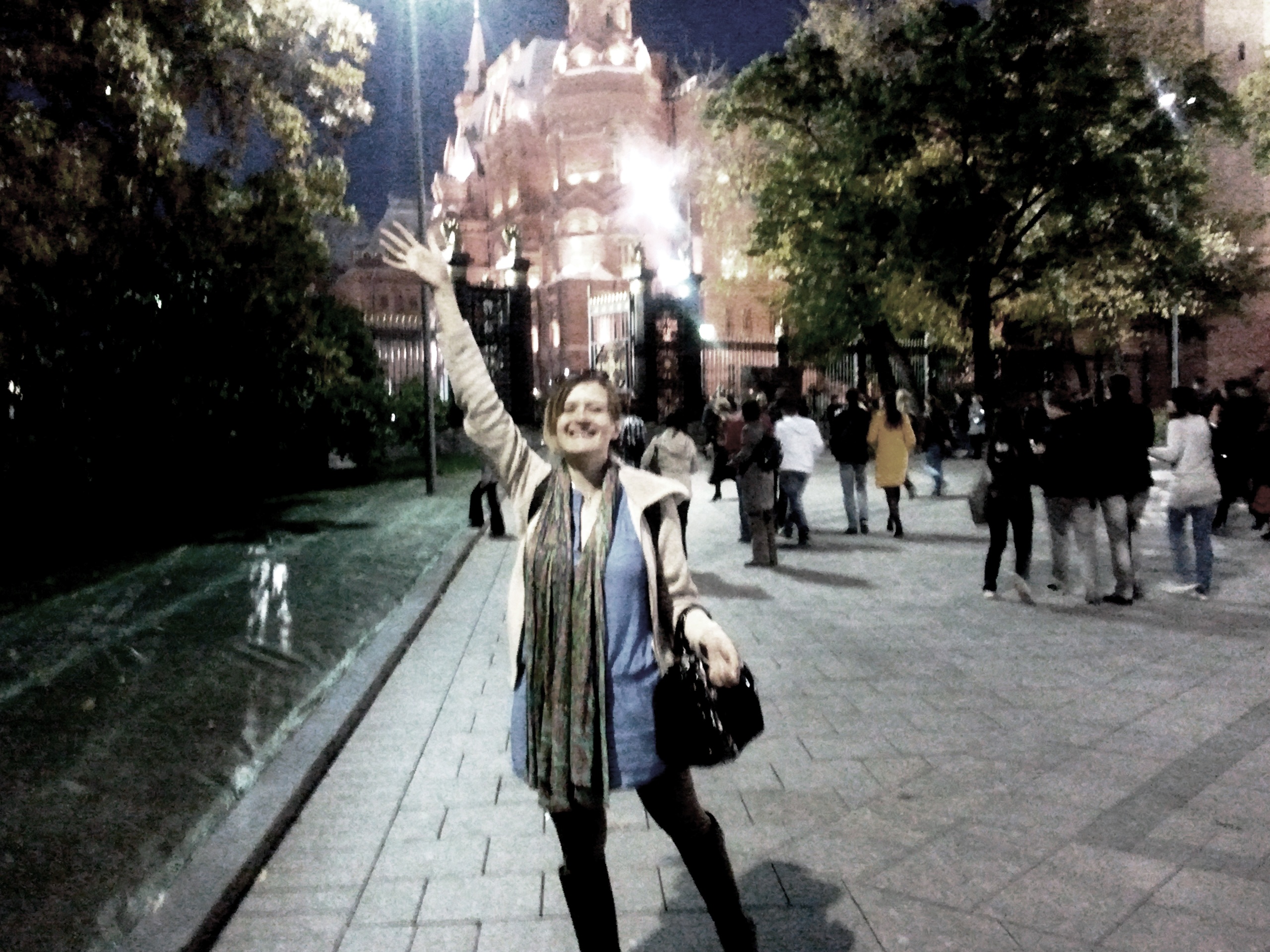
There are some things that are easier to do with my brother-in-law. Complaining is one of them. Taking pictures is another. My husband is a zealot when it comes to taking pictures. “Take that crap off your Facebook – you’re embarrassing me!” He roars whenever I snap a quick picture of Lyovka with my mobile phone. My brother-in-law isn’t like that. Which is why we ended up immortalizing our day out like this:
Next time, I'll teach him how to use the focus option on a Samsung phone. Also, my hand looks freakishly large.
My husband is off being an actor in Poland, and couldn’t stop us.
After I got tired of complaining, we just sat under the tree for a while and stared up at the leaves. When we looked down again, we witnessed a scene: Three scary riot policemen trying not to act indimidated when approached by a crazy woman with plastic bags hanging off her arms, her neck, and her belt. The crazy woman gesticulated wildly. The plastic bags contained ominous dark shapes. The scary riot policemen drifted over to the Eternal Flame, clasping their hands behind their backs and pretending to be fascinated.
People who stage protests in Moscow do not get it. You don’t deal with riot police by being all, “I have rights! They’re in the constitution! Look it up!” You deal with riot police by acting batshit insane – or so I’ve realized.
“These are the last warm days of autumn,” My brother-in-law said, apropos of nothing.
I handed him over to his wife by Okhotny Ryad and walked all the way to Tretyakovskaya, past Lenin’s Tomb, the glowing GUM, St. Basil’s, the infamous Moskovertsky bridge on which soldiers like to pick up young girls, and so on. Looking at St. Basil’s, I was reminded of how some of the girls at The Moscow News call each other “creampuff.” “Creampuff” should be the church-museum’s new nickname too. After extensive renovations that were going on back when I was 17, St. Basil’s certainly looks good enough to eat.
On the Moskva River people partied in boats and released balloons up into the evening air. Zamoskvorechye, my once and future neighbourhood, greeted me with its moonlit bell towers and boarded-up windows. Around the bend of the river stood the house where Lyovka was conceived, in a flat that once belonged to yet another tragic Soviet general (I sometimes wonder if there is any other kind). I could see in my mind the eyes of the portraits there, staring into the darkness. All of those beautiful, dead people – who will tell the world about them? It seems this task may fall to me.
I detoured to Pyatnitskaya. Two teenagers walked behind me and discussed their misadventures with making shashlik in the forest. There was the cafe I’d written my third play in. The store I went into when I ripped a stocking – the saleslady insulted me by pointing out that their stockings were all “very expensive.” The basement club in which my husband – who was not then my husband – first kissed me was already gone, and two old men leaned on their canes and argued in the dark courtyard as I passed it by. There was an old U2 song, from the days when Bono didn’t wear stupid glasses, playing somewhere in the distance. I wondered why so many people were milling about and remembered that it was Saturday. People go out on Saturdays.
One time, during the summer, when I was very pregnant with Lyovka, my husband – who was already my husband – grabbed me and kissed me on the corner of Pyatnitskaya, and then asked me if I had remembered. “Remembered?” “I kissed you here a long time ago. It was 5 a.m. You were getting into a cab. Your friends cheered.” “This happened right here?” “Yes, exactly here.” “They did cheer! Those bastards! Then they reenacted that scene over and over again when we got home.”
It’s just a street corner, but a part of us may haunt it in some fashion.
I mused on how spontaneous that whole evening turned out to be. My husband told me he had planned ahead – he had needed to pick a place where we wouldn’t just sit and talk until morning, but a place where we would sit and talk until the middle of the night, and then he could lead me away to dance.
“Oh my God!” I said. “There was a plot!”
You want that sort of thing. You want a handsome man who plots and spins his own narrative. When you’re a writer, you don’t want it to just be you all of the time. You want someone to collaborate with – and that’s what we do.
“I didn’t think I would marry him, of course! He was so much trouble at first!” I had told my brother-in-law earlier. “It mush have been some form of providence! Imagine – if we hadn’t fallen in love – there would be no Lyovka!”
My brother-in-law smiled and rolled his eyes simultaneously, as only he can do.
The metro took me east to be with Lyovka. I read Hans Christian Andersen on the ride over to Novogireyevo.
“It is the time of falling leaves and stranded ships, and soon icy winter will come.”
The first executions began at Babi Yar in Kiev, Ukraine. They began on September 27, to be exact. The first victims were patients at the local psychiatric hospital. They were murdered by Nazi occupiers together with local collaborators. Then the city’s Jewish population was taken there. They were told that they were being “resettled.” And you can guess what happened next.
Babi Yar is the final resting place of many, many people – mostly civilian Jews, as well as Soviet POWs, Ukrainian nationalists, Roma folks who were rounded up, etc. I am distantly related to some of the people who were murdered there, as a lot of Kievans are.
My first play featured an incident at Babi Yar as it is today, but I couldn’t do justice to the setting.
Poet Evgeny Yevtushenko wrote of Babi Yar: “I am like a constant, soundless scream, over the buried thousands. I am every old man shot to death here. I am every child shot to death here.” At the time that Yevtushenko wrote these words, the Soviet powers were still steadfastly refusing to place a monument at Babi Yar.
All of that has changed. And a museum is likely to be built. I guess that justifies the “Good News” tag, maybe.

 Natalia A.