Polanski’s sister-in-law, Mathilde Seigner, admits she is delighted the star will soon be free, telling French newspaper Le Parisien, “I am very happy and relieved. We’re going to drink a nice glass of champagne and toast together.” [source]
Yeah, and then he’ll throw in some forced sodomy, ’cause that’s just how he rolls. Seriously, you’re talking to the national media and you bring up champagne?
What’s worse: that these people are simply unaware of the impression they are giving the rest of the world, or that they are, in fact, very much aware, and couldn’t give a damn? And then they have the nerve to complain about how their family has been negatively affected by this situation? Because, clearly, the utter sense of entitlement and “it’s OK to get away with rape for as long as you’re a celebrated genius” means that society needs to roll over and drool for your benefit?
He better still get extradited. Otherwise, I might have to quit humanity.
There isn’t anything else I’d like to say about this, so I’ll let appropriate gif be appropriate:
So Stephanie Zacharek used her review of the film adaptation of The Road to bash the original source material. There’s no accounting for taste, but does Cormac McCarthy really have a “he-man streak”? And even if he does… why is that bad?
I rarely agree with Zacherek’s reviews, though I think she gets unfairly lambasted all of the time, and really don’t appreciate the meanness in the comments directed to her (Salon’s commenters, of which I frequently am one, have a bad reputation for a reason). I just don’t understand the criticism being leveled at McCarthy here, I guess. I still get chills just thinking about his description of the Man who contemplates whether or not anything is living in the sea – giant squid, perhaps. I mean, think about it, a post-apocalyptic wasteland in which a man dreams of squid in the cold, dark sea. I don’t even… That’s terrifying. And brilliant.
And the details of “The Road” — which must be particularly wrenching for people who have children, given that nearly every page stokes a common parental fear — repeatedly ask the same question: Are you man enough to take it?
You know, as a woman who read the book and enjoyed it – although perhaps the word “enjoyed” is wrong here, perhaps “admired” works better – I really didn’t get the sense that McCarthy was asking me if I was “man enough.” He was just telling a story in a hard (no pun intended), unflinching style. I didn’t think there was anything gendered about the way he was treating his readers or his subject matter. Sure, it’s a tale of a man and his son, and the mother is gone and not by accident, so there’s that aspect of it. But the man and his son didn’t make me feel as though I was an outsider at He-Man Thunderdome. If anything, I spent a long time thinking about my brother afterward, wondering if I’d be able to take care of him like that if shit should hit the fan. That’s because the writing is so personal; I think it clearly comes from a place wherein McCarthy himself was contemplating various scenarios, and wondering if he could take it.
[The director of “The Road”, John Hillcoat] also knows that sometimes it’s not just healthy to recoil — it’s essential.
Well now. First of all, you can’t deny that these are two different mediums we’re talking about here. Because of the way we interact with the written word, and because of the way that the written word interacts with us, there are images we can conjure up in books that don’t translate well when it comes to film. The gruesome image of an infant roasting on a spit is the one that Zacharek has particular issues with, and she praises Hillcoat for not dwelling on it in the film. I think that’s a little like praising Stanley Kubrick for not attempting to re-enact Nabokov’s image of “a sultan, his face expressing great agony (belied, as it were, by his molding caress), helping a callypygean slave child to climb a column of onyx.” Hells to the yeah! Who cares about Oscars, let’s start giving out Common Sense Awards!
I also think that there is quite a bit of “recoiling” going on in The Road, it’s just done in this very graceful, penetrating (bwahaha – OK, fine, I’m intending all of these puns) manner. Like many of the writers I admire, McCarthy writes beautifully about absolutely horrifying things. That’s not so much a recoil as it is an act of transcendence. And if you can’t avoid stepping in blood or shit, you might as well transcend it – is what I always say.
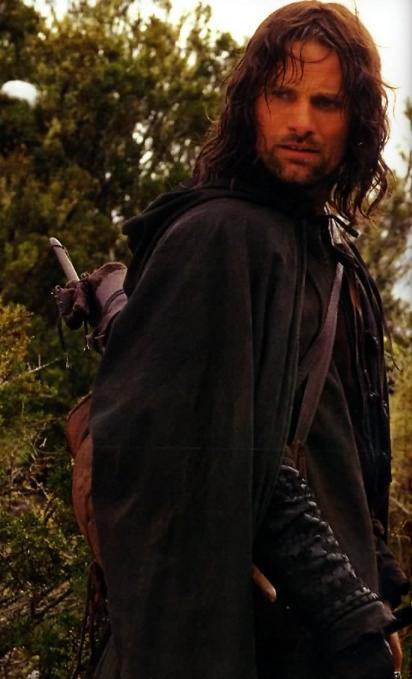
Anyway, all of this is very depressing. Let’s end this post on a happy note, by objectifying Viggo Mortensen for a second:
He may not have made a particularly excellent King, but he was still the best Strider a dork could hope for. Haters to the left.
I saw that the Lamb opened one of the seven seals, and I heard one of the four living creatures saying, as with a voice of thunder, “Come and see.”
There’s really nothing remotely clever or interesting that I can say about Babi Yar, aside from the fact that it’s a horrifying place to visit. Family members were murdered there, along with roughly 100,000 others, and I thought I could easily compartmentalize that. After all, I never knew them, right? But Babi Yar doesn’t really work like that. It has this crackling, living aura, and you can’t keep it at an arm’s length. You duck into the warm metro afterward, but it follows you.
My friend Egon is in town and I am busy being a terrible host, alongside the usual activities, such as trying to crawl under from beneath a pile of work. Still, Monday music is sacred.
Lorge – El Ten Eleven
Lapland – Ratatat
Thorn-torn Lips – Robert Berkman
Pretty Good Year – Tori Amos
In My Life – Johnny Cash
Heart of Gold – Neil Young
Profit – Ebba Grön
To the Dancers in the Rain – Emilie Simon
Slip – Deadmau5
Sh-Boom (Life Could Be a Dream) – Crew Cuts
I’ve heard all about this band, Radio 4, recently. Me likey.





 Natalia A.